 Swatch Out!
Name a paint chip in one word. Can the room find it on the wall?
- TV board
- Audience can join in
Start a room right here, and everyone joins on their phone with the code. Changed your mind? You can swap games in the lobby.
Swatch Out! is a colour-naming party game set in an old paint shop after closing time. Each round one player is the clue-giver. They get a secret paint chip from the Chip Wall and give it a one-word name, and everyone else drops a pin where they think that chip is.
Then the clue-giver adds a second clue to steer the room closer. It plays on phones, with the wall on the TV, and every colour deserves a silly name.
What you need
A phone each, and a TV or laptop for the Chip Wall if you have one. Colour assist helps anyone who needs it.
How to play
The goal
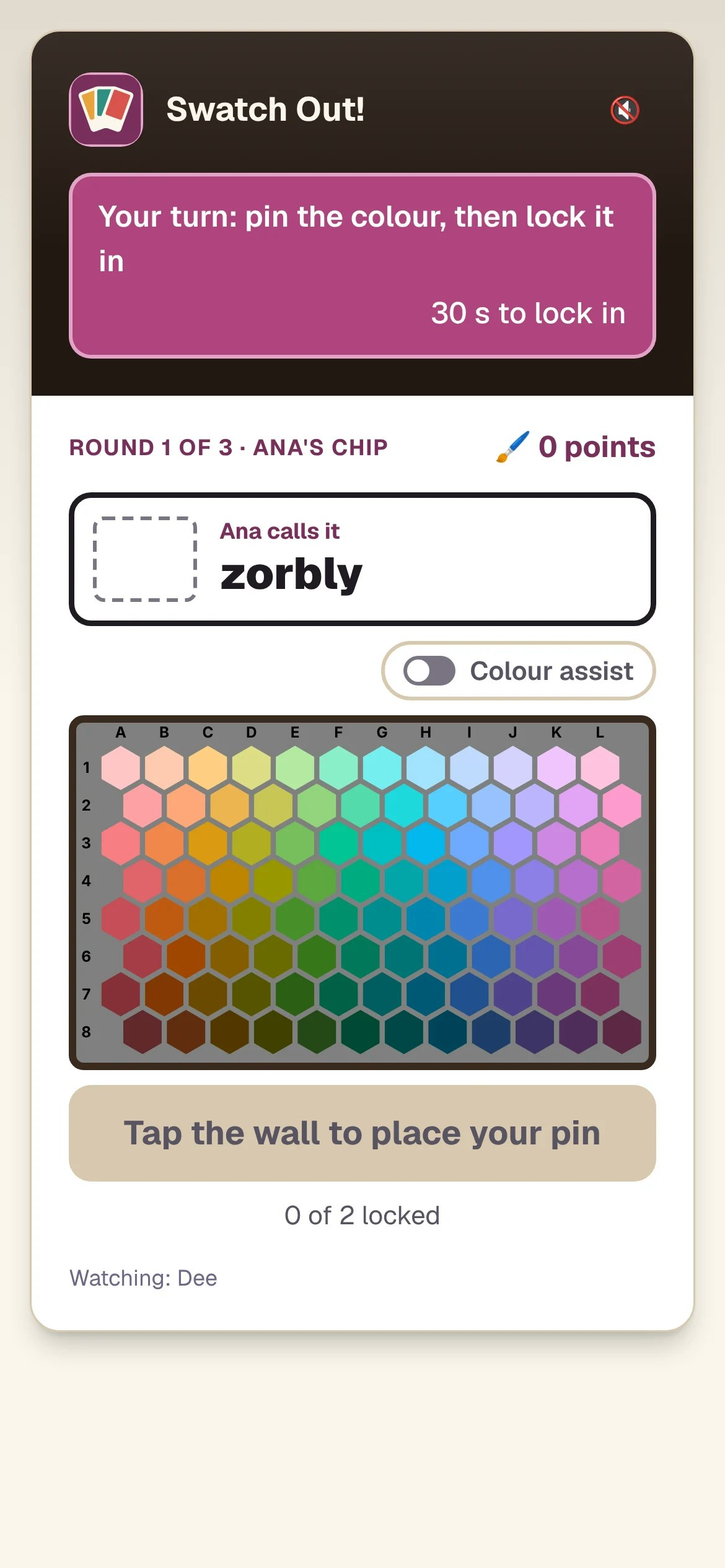
Name paint chips, and find them. Each round one player, the clue-giver, secretly picks a chip on the Chip Wall, a honeycomb of paint colours, and gives it a one-word Name. Everyone else drops a pin where they think it is. The closer your pin, the more points you score.
For 3–10 players. Anyone else in the room can watch and add a pin to the crowd cloud.
Hue runs across the wall and wraps round: the left and right edges are neighbours. Rows run from pale at the top to deep at the bottom.
On the Deep wall every spot has three layers, Muted, Mid and Vivid, from greyish to full colour. A layer away counts as one step, like a chip away.
Before starting, the VIP picks a Length (Short: everyone gives clues once. Long, unless they change it: twice with 3–4 players; with more, the game stops a few rounds into the second time around, so only some give clues twice), Pace (Relaxed, Normal or Quick timers), the Wall (Cozy: 96 bigger chips; Standard: 288; Deep: 648 on three layers), The Finish (on or off) and Bold namer (on or off).
Score is points (🖌️), and everyone gives clues once before anyone goes twice.
Each round
Paint card: the clue-giver is dealt 3 chips from different parts of the wall and picks one (15 seconds; the first is used after that).
The Name: the clue-giver types one word (25 seconds). If they don't, the paint has dried: nobody scores this round.
First pins: everyone else drops one pin on the wall (30 seconds, or until everyone has locked). Pins are secret until everyone's in; then they all appear on the TV and every phone.
The Finish: the clue-giver sees the pins and adds up to 2 more words (25 seconds). Or they go Bold: skip the Finish ("That says it all") and their points this round are doubled.
Keep or move: each guesser keeps their pin or moves it (25 seconds). Moves stay secret until the reveal.
The reveal: the secret chip, every pin's distance and points, and the Name and Finish on a paint card.
Pass: once a lap, the clue-giver may hand the turn to the next player before picking, with no penalty. They name the round after instead.
Pace scales every timer: Relaxed is half as long again, Quick is about two-thirds. With The Finish off, there's one word and one pin.
Names and Finishes
The Name is one word; the Finish is one or two. Each at most 24 characters.
No colour words (red, teal, beige, bluish…), no family names on the wall (Lagoon, Plum…), no position words (light, dark, pale, deep, bright…), and no word that starts with one: "redwood" and "bluebell" are out, "bread" is fine.
No chip codes like
K7, no numbers, and keep it friendly.
Points
Your pin scores by how many chips away it is from the secret chip, round the wrap: the same chip 5, one away 3, two away 1, further 0. No pin scores 0.
Called it: a pin you kept after the Finish that scores at all gets +1.
The clue-giver gets 1 for every guesser's pin that scores, plus 2 if anyone hits the exact chip. Bold doubles it.
The audience's pins are shown at the reveal as a crowd cloud. They never score.
Colour on every screen
Screens differ. Name what you see, and use the wall's neighbours. Night Shift or a blue-light filter on? Switch it off for this game.
Scoring uses where a chip is on the wall, never how it looks on a screen, so a wonky TV can't make it unfair.
Colour assist: anyone can switch it on for themselves on their own phone. It names each chip's family, code and lightness ("Lagoon, K7, pale").
Pins are shapes and initials, so nothing else depends on colour.
Winning
After the last round, the most points wins: they're the Master Mixer. Players with the same points share it.
The game over screen also shows the Sharpest Eye (most exact chips), the Best clue-giver (most points as the clue-giver) and the Paint Card wall: every round's chip with its Name and Finish.
Screenshots

Questions
Can kids play?
Older kids, yes. You'll need to read and type a word, and it helps to know your colours.
How long does it take?
Everyone gives clues once or twice, picked by the VIP. The VIP picks how long a game runs in the lobby, and the time beside the intro is a typical game.
Do we need a TV?
No. Everyone can play on their phones alone. A TV or laptop that everyone can see makes it better, because the board, the reveals and the scores go up there.
You might also like
More games
 Gloat Show
A quiz show where being right is good and being right first is better.
2–10 players
 Mini Party
Tiny games, a few seconds each. Everyone plays at once, so nobody waits.
1–10 players
 20 Questions
One secret word, one hint at a time. Guess early if you dare.
2–10 players


